A city budget is a policy, planning, and fiscal document all in one. CUNY ISLG’s staff includes former senior city and state government officials, budget directors, and department heads; tapping into this knowledge, we developed this guide—and series—for policymakers, legislative staff, researchers, advocates, and the public to clarify the New York City budget process
This means shedding light on who makes key decisions, how and when decisions take shape, and where there are opportunities to provide input.
How to Use This Guide
A city budget is a policy, planning, and fiscal document all in one. It lays out day-to-day costs, long-term capital projects, and revenue sources, and generally serves as a blueprint for city leadership’s priorities. Creating the budget is a complex, iterative process that involves partners from across the geographical and ideological spectrum.
The CUNY Institute for State & Local Governance works with policymakers, agency leadership, and the community to make public systems work for everyone. ISLG’s staff includes former senior city and state government officials, budget directors, legal experts, and department heads as well as community practitioners. Tapping into this knowledge, we developed this guide—and series—for policymakers, legislative staff, researchers, advocates, and the public to clarify the New York City budget process.
This guide is meant to shed light on who makes key decisions, how and when decisions take shape, and where there are opportunities to provide input.Part of the Inside the New York Budget Process series, this guide is meant to shed light on who makes key decisions, how and when decisions take shape, and where there are opportunities to provide input. This work complements the NYC Independent Budget Office’s Budget 101 resource by focusing on how the budget process operates in practice. Together, the two publications provide both the formal framework and the practical context needed to understand New York City’s budget process.
Whether you are a legislator, executive official, advocate, researcher, student, journalist, or interested citizen, this series is intended to help you better understand—and more effectively participate in—how money is allotted in New York City.
For details on the New York State budget process, see our State-specific report. The final report in our three-part series will cover how City and State processes work in tandem.
The Timeline, Actors, and Access Points
of the New York City Budget Process
This timeline provides a high-level overview of the numerous phases of the New York City budget process, the key participants at each stage, and access points for influencing budget decisions.
The New York City budget is a continuous year-round process involving the New York City mayor, City Council, comptroller, Independent Budget Office (IBO), Financial Control Board, city agencies, community boards, borough presidents and borough boards, advocacy organizations, and the public. As one annual budget is adopted and implementation begins, planning for the next is already underway. The ongoing nature of the budget process creates opportunities throughout the year for actors to influence priorities and funding decisions.
The timeline laid out in this guide traces the budget from adoption through implementation and into development of the next fiscal year's budget. It identifies the major milestones established by the City Charter, the principal participants, and opportunities for engagement at each stage of the process.
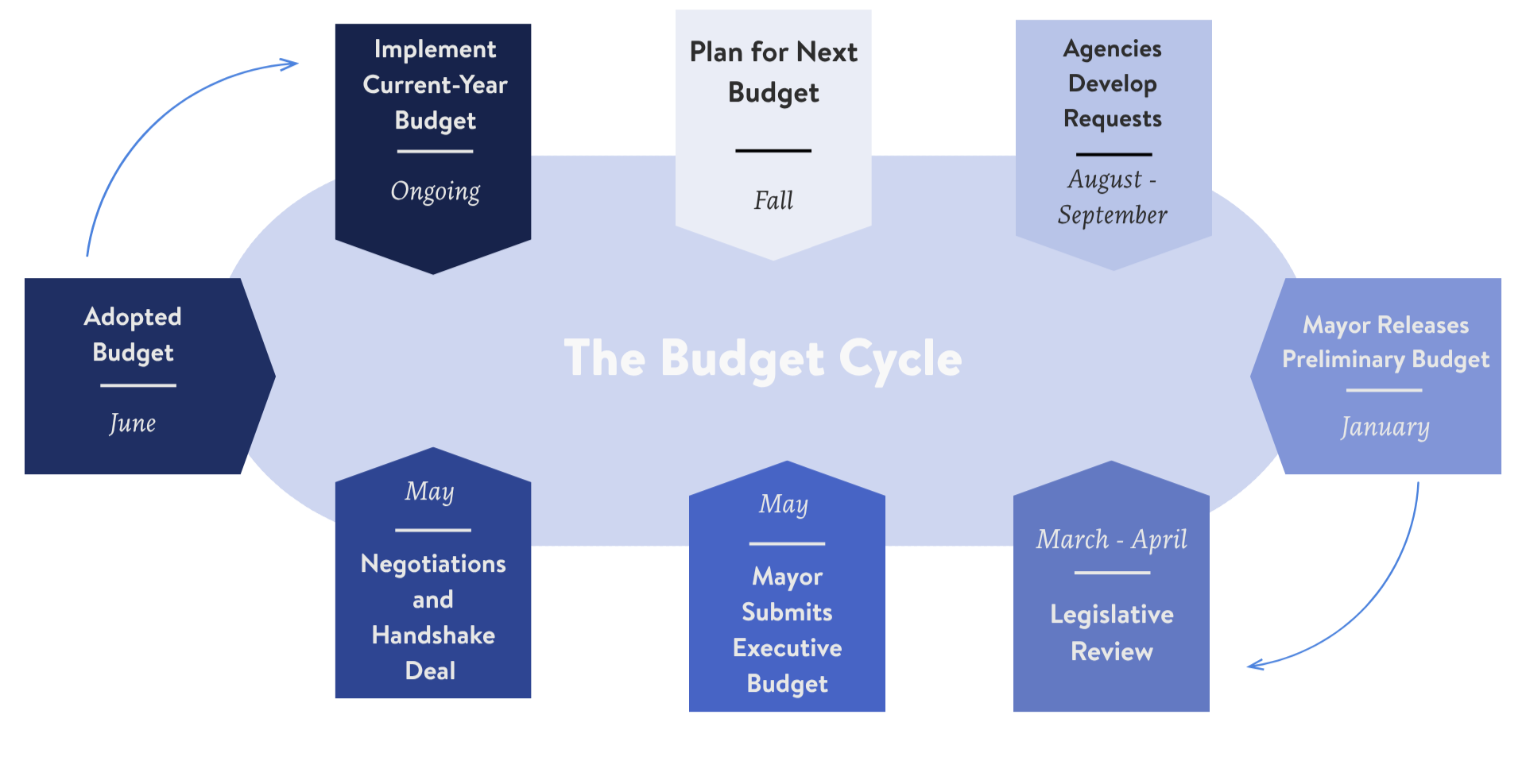
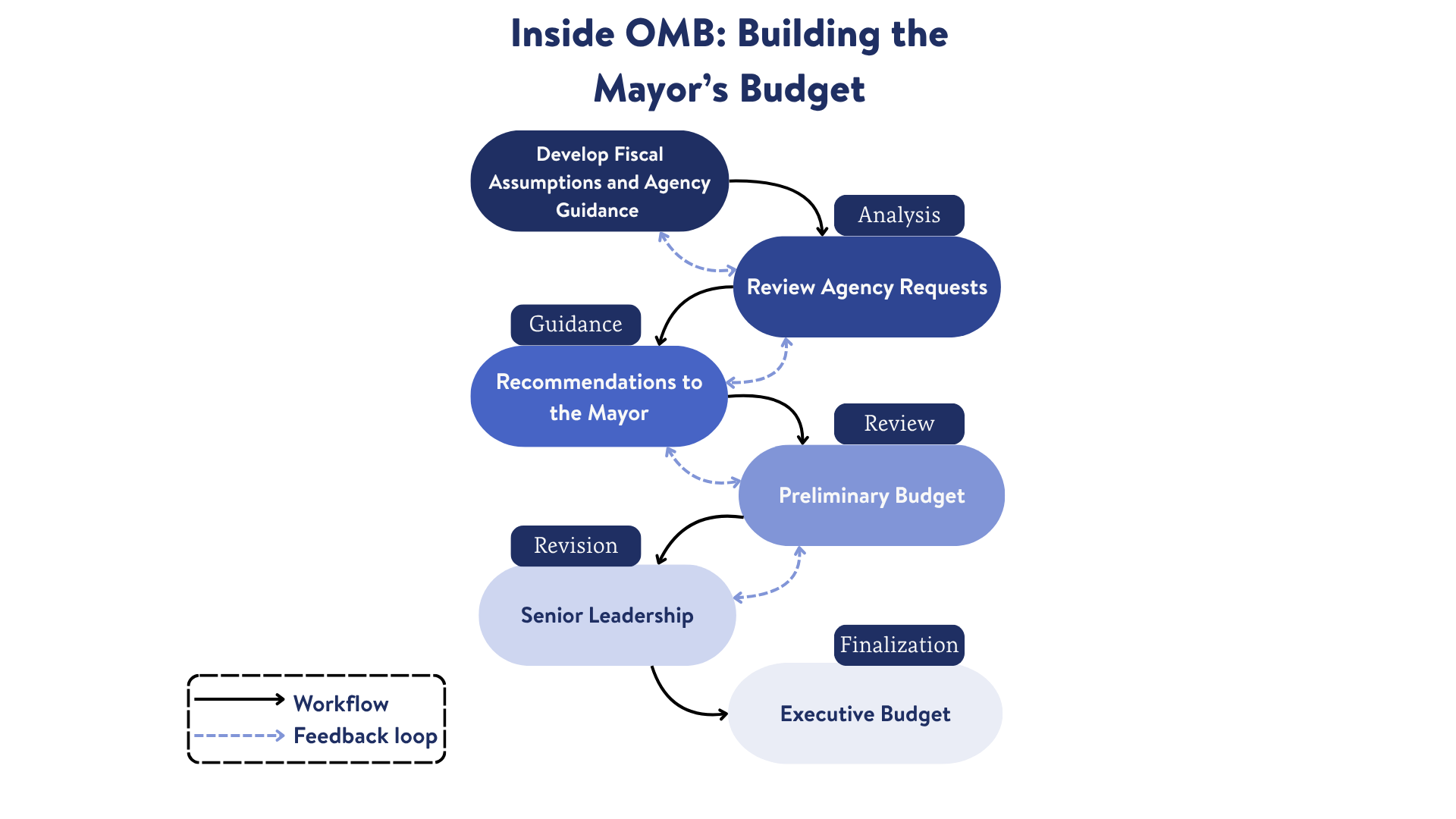
Almost immediately following budget adoption for the current fiscal year, the Office of Management and Budget (OMB) begins planning for the next fiscal year’s budget. To initiate the first steps in the budget process, OMB develops and issues the annual administrative budget calendar and begins developing fiscal assumptions and guidance for agencies.

Community Boards Identify Budget Priorities (July-October)
Under the New York City Charter, each of the city’s 59 community boards submits its expense and capital budget priorities to the mayor and its respective borough president 30 days before agencies submit their departmental estimates to OMB. Community board priorities are advisory, intended to influence agency budget requests and the mayor's Preliminary Budget.
OMB Issues Budget Guidance (July-August)
OMB provides the framework to guide agency budget submissions in the form of budget call memoranda and agency target letters. OMB guidance includes
- the mayor’s priorities; anticipated fiscal constraints;
- savings targets (if required);
- hiring and staffing instructions; and
- revenue expectations.
OMB and DCP Develop the 10-Year Capital Strategy (Summer-Fall)
In odd-numbered years, OMB and the Department of City Planning (DCP) prepare a 10-Year Capital Strategy, a planning document that identifies the City’s long-term infrastructure needs over the next 10 years and helps inform future capital budgets.
Participatory Budgeting NYC Begins (Summer-Spring)
Through a participatory process separate from the traditional budget process, community members are given the opportunity to directly decide how to spend a portion of the city budget. Participatory budgeting begins in the fall with idea collection and the recruitment of volunteer delegates who narrow down project proposals. The process continues through the spring, culminating in a public vote and the inclusion of winning projects in the final budget.
Budget Review and Preparation
(August-January)
Agencies Prepare Budget Requests (August-September)
Guided by OMB's budget instructions, City agencies begin preparing budgets, developing department estimates, identifying baseline spending, and identifying savings and efficiency proposals. Agencies work with OMB to develop cost estimates for proposed new initiatives that include staffing, operating, contractual, and capital costs. OMB evaluates these estimates for fiscal soundness, sustainability, and consistency with the mayor's policy and fiscal priorities.
Agencies work with OMB to develop cost estimates for proposed new initiatives that include staffing, operating, contractual, and capital costs. OMB Begins its Review (September-November)Following submission of agency budget requests, OMB begins an iterative review with city agencies to incorporate the mayor’s priorities and fit department spending requests within available fiscal resources. Throughout, spending proposals are refined, implementation plans are reviewed, and savings opportunities are evaluated.
-
OMB manages the City's budget on behalf of the mayor. Working closely with City Hall and agency leadership, OMB develops a budget that advances the mayor's priorities while maintaining fiscal balance and complying with legal and financial planning requirements.
Budget preparation begins months before the release of the Preliminary Budget and continues throughout the fiscal year. Rather than a single event, it is an iterative process involving agency submissions, financial analysis, policy evaluation, and negotiations.
OMB Major Responsibilities
Develop the City's official revenue forecast and financial assumptions
Issue budget guidance, fiscal targets, and policy priorities to agencies
Review agency budget requests, staffing plans, and new initiatives
Negotiate funding levels, savings proposals, and program changes with agency leadership
Evaluate proposals for affordability, policy alignment, and long-term fiscal impact
Prepare recommendations for the mayor
Develop the Preliminary Budget and Four-Year Financial Plan
Revise the budget following public review and negotiations to prepare the Executive Budget
Monitor revenues, expenditures, and agency performance throughout the fiscal year
Prepare budget modifications as fiscal conditions, grants, emergencies, labor agreements, or policy priorities change
Mayor Reviews and Finalizes Budget Decisions (November-December)
As OMB analysis continues, major policy decisions are presented to the mayor and senior Executive officials for review, discussion, and decisions. The mayor ultimately determines which initiatives, funding levels, savings proposals, and policy priorities to incorporate into the Preliminary Budget.
Mayor Releases the November Financial Plan Update (November)
The November Plan is the first formal update to the Adopted Budget after the start of the fiscal year. OMB releases this plan each year. The November Plan revises revenue forecasts, spending estimates, staffing levels, and the city’s four-year financial plan to reflect current conditions.
The Comptroller Reports on the City’s Finances (November-December)
In December, the Comptroller publishes reports on the city's fiscal condition, debt, and financial outlook. This independent assessment provides policymakers with an evaluation of the city's fiscal health and informs budget planning and public discussion as the mayor prepares the Preliminary Budget.
Information collected and analysis conducted over the course of the summer and fall informs the Administration’s construction of the budget.
The Mayor Releases the Preliminary Budget and Four-Year Financial Plan (January)
The mayor submits the Preliminary Budget to the City Council in January. This budget establishes the framework for negotiations that occur over the following months. The budget is presented as a package of core budget documents—most of which the Charter mandates—including the Four-Year Financial Plan, 10-Year Capital Strategy and Preliminary Certificate, which establishes a limit on the amount of capital spending that cannot be exceeded throughout the negotiation amendment process with the City Council (see the Budget Resources appendix for a complete list).
Mayor Releases the November Financial Plan Update (November)
The November Plan is the first formal update to the Adopted Budget after the start of the fiscal year. OMB releases this plan each year. The November Plan revises revenue forecasts, spending estimates, staffing levels, and the city’s four-year financial plan to reflect current conditions.
The Comptroller Reports on the City’s Finances (November-December)
In December, the Comptroller publishes reports on the city's fiscal condition, debt, and financial outlook. This independent assessment provides policymakers with an evaluation of the city's fiscal health and informs budget planning and public discussion as the mayor prepares the Preliminary Budget.
IBO Publishes an Analysis of the Preliminary Budget and Financial Plan (February)
By February, the Independent Budget Office (IBO) provides the Council and the public with an independent assessment of the Preliminary Budget. It evaluates the administration's budget assumptions and identifies fiscal risks that could affect the city's financial plan.
Community Boards Review the Preliminary Budget (January-February)
Each community board releases an assessment of the Preliminary Budget’s responsiveness to its budget priorities.
Borough Boards Hold Preliminary Budget Hearings (February)
Each borough board holds at least one public hearing to review the Preliminary Budget and consider borough priorities.
Mayor Testifies at the New York State Joint Legislative Budget Hearing (February)
Annually, the mayor presents testimony in the State Capitol before the Senate Finance and Assembly Ways and Means committees in a joint hearing on Local Assistance to present the City’s priorities for inclusion in the final State budget. This is a key milestone due to the City’s reliance on the State for funding and legislative authorizations covering many of the City’s programs and revenue sources. The joint hearings provide state actors with an opportunity to assess City finances.
Borough Presidents Submit a Statement on the Preliminary Budget (March)
Following the public and community review and recommendation process, each borough president recommends modifications to the Preliminary Budget. These are transmitted through a formal Statement on the Preliminary Budget to the mayor, City Council, and relevant borough president. By City Charter, the mayor is obliged to consult with borough presidents when preparing the Executive Budget
Review and Issuance of the 10-Year Capital Strategy (March-April)
Every odd-numbered year and by March 16, the City Planning Commission (CPC) reviews the 10-Year Capital Strategy, conducts a public hearing, and submits comments and recommendations to the mayor, the City Council, and the borough presidents. The Charter directs the mayor to issue and publish the final Capital Strategy by April 26.
-
The mayor, along with City Hall senior staff, establishes the administration's priorities and makes the final decisions on major spending, savings, and policy initiatives. Throughout the process, the mayor, deputy mayors, chief of staff, and OMB leadership meet regularly to review agency proposals, evaluate competing priorities within fiscal constraints, and ultimately decide which initiatives will move forward.
These decisions evolve over months of ongoing discussions. Fiscal limits, policy priorities, and operational challenges are refined, modified, deferred, or sometimes expanded before being incorporated into the mayor's Preliminary and Executive Budgets.
City Hall Major Responsibilities
Establish the administration's priorities
Review agency proposals and initiatives
Balance competing priorities across agencies
Evaluate tradeoffs weighing budget investments fiscal risks
Resolve issues that cannot be settled at the agency or OMB level
Make final decisions
The City Council's formal role in the budget process begins with its review of the mayor's Preliminary Budget. Executive agencies and senior staff are often asked to brief City Council members and staff outside of the Council’s formal hearings. See Inside the City Council: Reviewing and Shaping the Budget in subsequent sections for a summary.
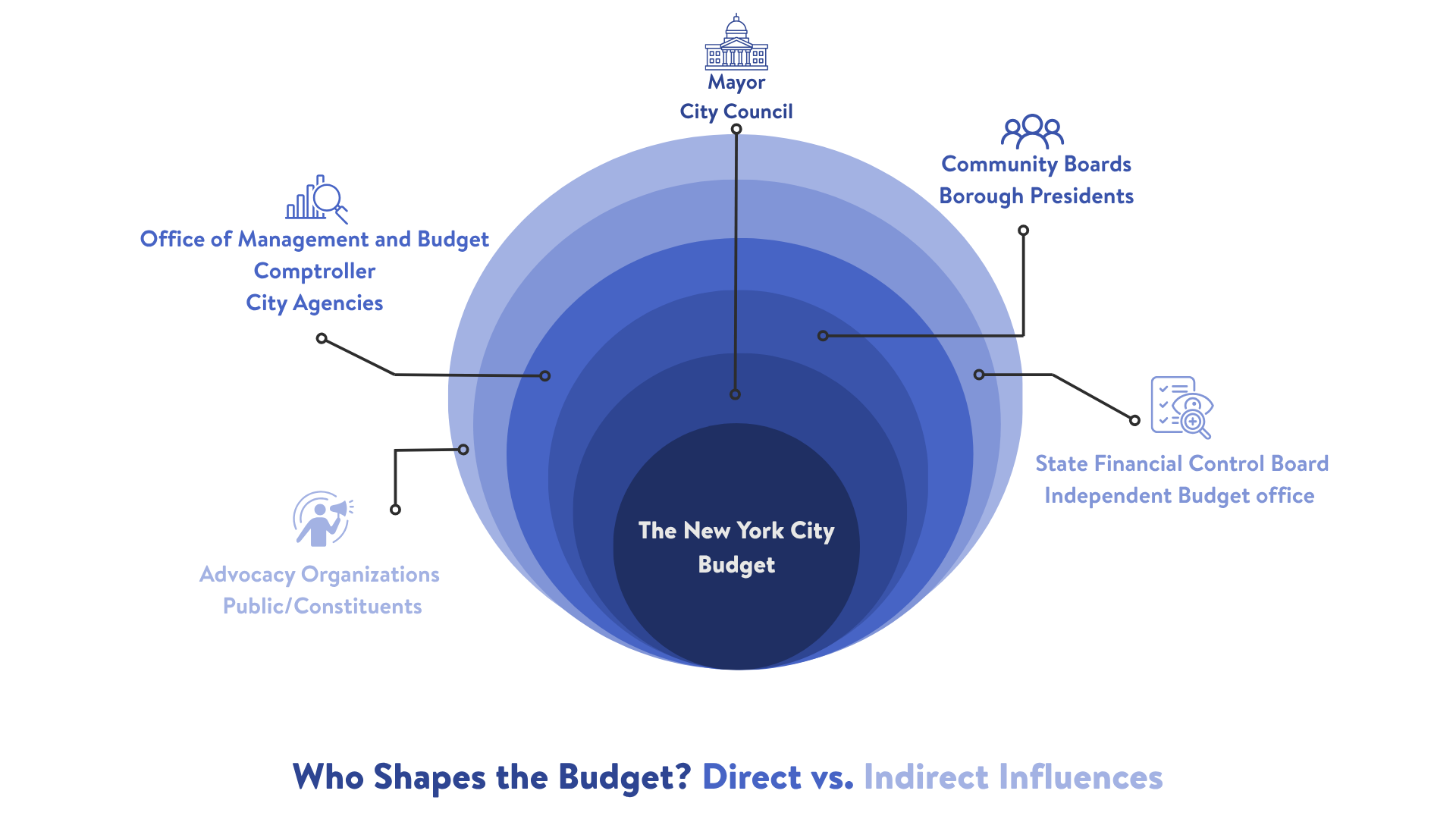
Budget Hearings Are Held (March-April)
Through a series of public hearings, the Council examines agency budgets, evaluates the administration's fiscal assumptions, and gathers testimony from City agencies, OMB, IBO, the comptroller, advocacy organizations, labor representatives, and members of the public. Because these hearings occur after months of budget development by City departments, community boards, borough presidents, and OMB, they provide the City Council with its first comprehensive opportunity to assess the mayor's proposed budget and identify potential changes.
The governor and legislative leaders oversee a complicated negotiation process involving members and staff at many levels of government. Matters may move from staff to committee chairs, back to staff, and up to leadership for resolution. Proposals are revised, agreements are reached and revisited, and issues move back and forth until the parties can reconcile their differences. At its core, negotiation is about making trade-offs to reach agreement on a final budget.
-
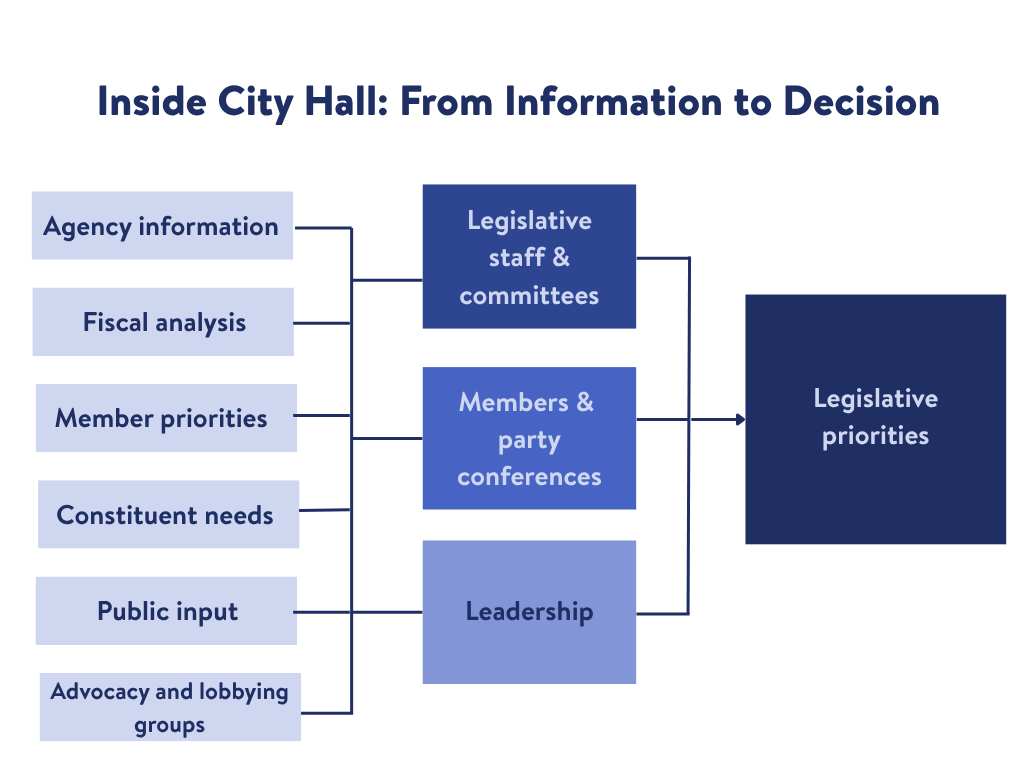
While the City Charter establishes the City Council's formal role in the budget process, it provides little direction on how the City Council organizes its internal review. In practice, the City Council uses a committee-based process to analyze agency budgets, gather public input, negotiate priorities, and develop its recommendations and amendments.
Although hearings are the City Council's formal mechanism for reviewing the budget, much of its work occurs outside the hearing room. Throughout the budget cycle, City Council leadership, committee staff, OMB, agency officials, and the mayor's office negotiate funding levels, policy priorities, and budget modifications. These discussions shape the Council's recommendations, amendments, and ultimately the city's Adopted Budget.
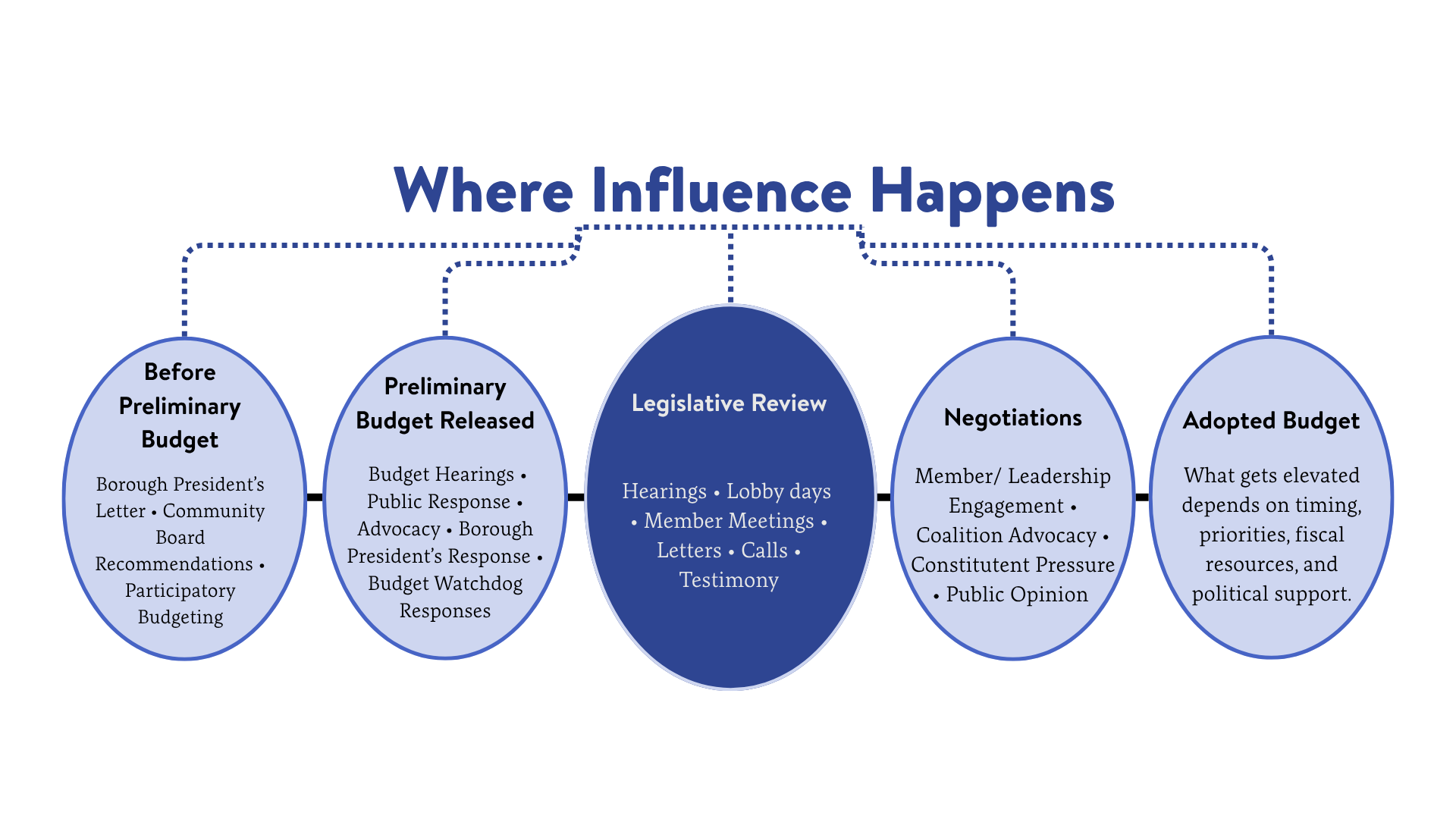
The Council Issues Its Preliminary Budget Response (March-April)
The City Charter requires the City Council to submit its response to the mayor's Preliminary Budget within 50 days of receiving the Preliminary Budget.
In developing the response, City Council staff gathers testimony from stakeholders, reviews the Preliminary Budget along with the accompanying analyses from the comptroller and IBO, and consults with City Council members.
The Executive Budget (May-June)
The Executive Budget marks the final stage of budget development before the City Council considers adoption of the City's spending plan.
The Mayor Submits the Executive Budget (May)
By May 1, after months of budget development, public review, and executive decision-making, the mayor releases the Executive Budget. This establishes the framework for the final negotiations and legislative action that result in the Adopted Budget.
The Council Holds Executive Budget Hearings(May)
Following the release of the Executive Budget, the City Council begins its final review with a second round of public hearings, where updated testimony and information from City agencies and senior staff, OMB, the comptroller, IBO, and the public is gathered. The City Council then negotiates and finalizes funding and policy issues with the administration.
The Handshake Deal: Budget Negotiations and Resolutions ((May)
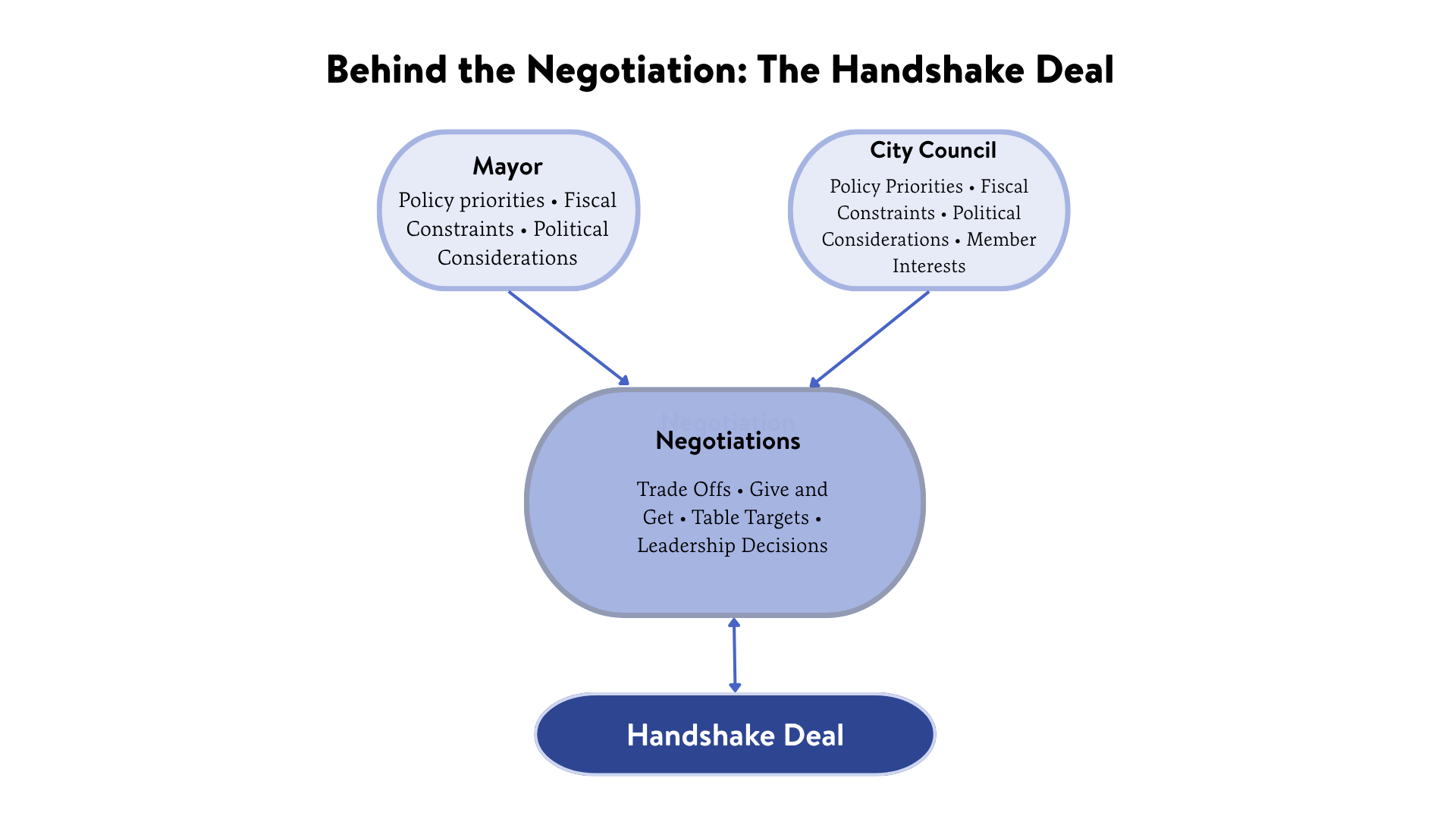
Negotiations between the mayor and the City Council are an ongoing, iterative process during which deals are made between the two parties. These deals result in amendments to the Executive Budget. While the City Charter provides the formal process for the City Council to amend the budget,1
and for the mayor to veto Council changes to the Executive Budget, the final Adopted Budget is typically negotiated via a handshake deal, a verbal agreement on the contents.Once this verbal commitment is made, the Executive Budget is amended and placed before the Council for vote and passes by a majority of members. This vote produces the Adopted City Budget, the city's final legally authorized budget for the fiscal year.
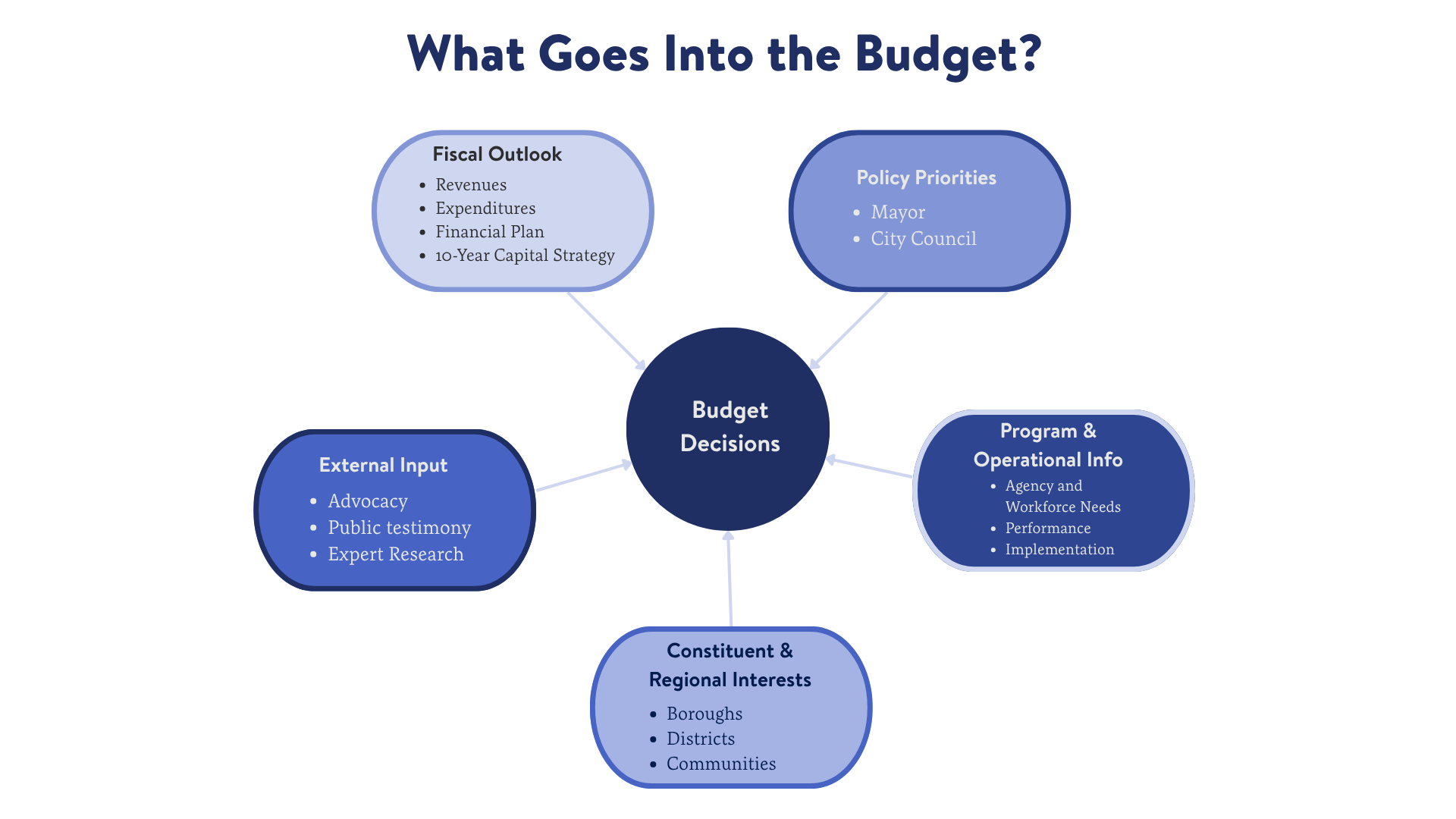
The Executive Budget marks the final stage of budget development before the City Council considers adoption of the City's spending plan.
The Mayor Submits the Executive Budget (May)
By May 1, after months of budget development, public review, and executive decision-making, the mayor releases the Executive Budget. This establishes the framework for the final negotiations and legislative action that result in the Adopted Budget.
The Council Acts on the Executive Budget (May)
Following the release of the Executive Budget, the City Council begins its final review with a second round of public hearings, where updated testimony and information from City agencies and senior staff, OMB, the comptroller, IBO, and the public is gathered. The City Council then negotiates and finalizes funding and policy issues with the administration.
The City Charter allows the City Council to directly amend the Executive Budget. In practice, however, the City Council and administration negotiate changes to the budget, arriving at what insiders call a handshake deal before the administration produces an updated budget that reflects those negotiations.
The Handshake Deal: Budget Negotiations and Resolutions ((May)
Negotiations between the mayor and the City Council are an ongoing, iterative process during which deals are made between the two parties. These deals result in amendments to the Executive Budget. While the City Charter provides the formal process for the City Council to amend the budget,1
and for the mayor to veto Council changes to the Executive Budget, the final Adopted Budget is typically negotiated via a handshake deal, a verbal agreement on the contents.Once this verbal commitment is made, the Executive Budget is amended and placed before the Council for vote and passes by a majority of members. This vote produces the Adopted City Budget, the city's final legally authorized budget for the fiscal year.
Tax Fixing: Translating the Budget into Property Tax Rates (May)
After the budget is approved, the City Council adopts a Tax Fixing Resolution establishing the property tax rates needed to support the adopted budget. Prepared by OMB, this resolution determines the amount that must be raised through the property tax levy and calculates the tax rates for each property tax class in accordance with the City Charter and state law.
Work on the next fiscal year’s budget begins as soon as the current budget is adopted. OMB continues the rolling budget process with its initial planning, and the cycle begins again.
Many actors shift from budget development to budget execution after the final budget is adopted. City agencies move from advocating for resources to managing allocated resources.
OMB Budget Monitoring and Adjustments (Throughout the Fiscal Year)
OMB continuously monitors agency spending, staffing, revenues, and financial performance to ensure that the budget remains balanced. As fiscal conditions evolve, OMB may work with agencies to address emerging needs and conditions and may recommend budget modifications.
Budget Modifications (As Needed)
Throughout the fiscal year, the administration periodically proposes budget modifications to reflect changing fiscal conditions, grants, spending needs, labor agreements, emergencies, and policy decisions. Routine administrative adjustments may be made by the administration, while more significant changes to appropriations are subject to City Council review or approval as provided by the City Charter.
Throughout the fiscal year, the administration periodically proposes budget modifications to reflect changing fiscal conditions, grants, spending needs, labor agreements, emergencies, and policy decisions.City Council Oversight (Throughout the Fiscal Year)
The City Council exercises oversight of budget implementation through hearings, finance staff reviews, and ongoing evaluation of agency performance and fiscal conditions.
State Financial Oversight (Continuous)
The New York State Financial Control Board, established by New York State law during the city’s 1970s fiscal crises, provides ongoing state oversight of the City's financial plans. The Board reviews the city's four-year financial plan at least quarterly, monitors the plan’s compliance with the State Financial Emergency Act, and annually determines whether conditions warrant reinstating a control period. That determination is typically made in July.
City Council Oversight (May)
The City Council exercises oversight of budget implementation through hearings, finance staff reviews, and ongoing evaluation of agency performance and fiscal conditions.
Budget Resources
Primary Legal Sources: The New York City Charter
Chapter 6 - expense budget. Chapter 6 - EXPENSE BUDGET - NYC Charter 0.0.1 documentation. (n.d.). https://nyccharter.readthedocs.io/c06/[MD1]
Chapter 8 - City planning. Chapter 8 - CITY PLANNING - NYC Charter 0.0.1 documentation. (n.d.). https://nyccharter.readthedocs.io/c08/
Chapter 10 - budget process. Chapter 10 - BUDGET PROCESS - NYC Charter 0.0.1 documentation. (n.d.). https://nyccharter.readthedocs.io/c10/
Chapter 12 - obligations of the city. Chapter 12 - OBLIGATIONS OF THE CITY - NYC Charter 0.0.1 documentation. (n.d.). https://nyccharter.readthedocs.io/c12/
Official Publications
New York City Council Budget Process: The budget process. Budget. (n.d.). https://council.nyc.gov/budget/process/
Community Board Statement of District Needs and Budget Requests (July-October): Bronx District 09. (2025, December). FY2027 CD needs statement - CB Bronx. Statements of Community District Needs and Community Board Budget Requests. https://cbbronx.cityofnewyork.us/cb8/wp-content/uploads/sites/3/2026/02/FY2027_Statement_BX08.pdf
Register of Community Board Requests for the Preliminary Budget (agency response to community board budget priorities): The City of New York. (n.d.-c). Register of Community Board Budget Requests for the Preliminary Budget Fiscal Year 2027 - Bronx. NYC.gov. https://www.nyc.gov/assets/omb/downloads/pdf/feb26/cbrboro2-26.pdf
Departmental Estimates (October): Mayor’s Office of Management and Budget. (n.d.). Departmental Estimates. The City of New York Fiscal Year 2027. https://www.nyc.gov/assets/omb/downloads/pdf/feb26/de2-26.pdf
Mayor’s Office Financial Plan (November): Mayor’s Office of Management and Budget. (n.d.). Office of Management and Budget. nyc.gov. https://www.nyc.gov/content/omb/pages/fiscal-year-2025/fy2025-2028-november-financial-plan#quickLinkAnchor2
Comptroller’s report (December): Office of the New York City Comptroller Mark Levine. (2025, December 15). Annual state of the city’s economy and finances 2025. Comptroller.NYC.gov. https://comptroller.nyc.gov/reports/annual-state-of-the-citys-economy-and-finances-2025/
IBO Fiscal Projection Report (February): New York City Independent Budget Office. (2026, March 26). Analysis of the 2027 preliminary budget. IBO.NYC.gov https://www.ibo.nyc.gov/assets/ibo/downloads/pdf/city-budget-overview/2026/2026-march-analysis-of-the-2027-preliminary-budget.pdf
Borough President Statement on Preliminary budget (March):
Manhattan Borough President Office. (2026b, April 1). Manhattan Borough President’s Recommendations for Modifications to the Mayor’s Preliminary Budget - Fiscal Year 2027. manhattanbp.nyc.gov. https://www.manhattanbp.nyc.gov/wp-content/uploads/2026/04/04.01.2026-MBPO-Preliminary-Budget-Response-FY2027-1.pdf
Brooklyn Borough President Office. (2026, March 31). Brooklyn Borough president’s response to the mayor’s preliminary budget fiscal year 2027 per New York City charter chapter 10, Section 245 – office of the Brooklyn Borough president Antonio Reynoso. BrooklynBP.NYC.gov. https://www.brooklynbp.nyc.gov/brooklyn-borough-presidents-response-to-the-mayors-preliminary-budget-fiscal-year-2027-per-new-york-city-charter-chapter-10-section-245/
10-Year Capital Strategy Plan (published every odd-numbered calendar year in April): Mayor’s Office of Management and Budget and Department of City Planning. (2025, January). Preliminary Ten Year capital strategy FY 2026-2035. NYC.gov. https://www.nyc.gov/assets/omb/downloads/pdf/jan25/ptyp1-25.pdf
City Council’s Response to Preliminary Budget (March-April): New York City Council. (2026, April 1). Fiscal year 2027 preliminary budget response. Council.NYC.gov. https://council.nyc.gov/budget/wp-content/uploads/sites/54/2026/04/Fiscal-Year-2027-Preliminary-Budget-Response-2.pdf
Handshake Deal (May-June): Office of the Mayor . (2026, June 30). Transcript: Mayor Mamdani announces handshake agreement on fiscal year 2027 budget. The official website of the City of New York. https://www.nyc.gov/mayors-office/news/2026/06/transcript-_mayor-mamdani-announces-handshake-agreement-on-fisca
Core and Executive Budget Documents – Preliminary Budget
Mayor’s Office of Management and Budget. (2026, February 17). The City of New York Preliminary Budget Fiscal Year 2027. NYC.gov. https://www.nyc.gov/assets/omb/downloads/pdf/feb26/perc2-26.pdf
Mayor’s Office of Management and Budget. (2026, February 17). February 2026 Financial Plan Detail, Fiscal Years 2026 - 2030. NYC.gov. https://www.nyc.gov/assets/omb/downloads/pdf/feb26/tech2-26.pdf
Mayor’s Office of Management and Budget. (2026, February 17). The City of New York Fiscal Year 2027. Mayor Departmental Estimates. https://www.nyc.gov/assets/omb/downloads/pdf/feb26/perc2-26.pdf
Mayor’s Office of Management and Budget. (2026, February 17). The City of New York Fiscal Year 2027. Preliminary Capital Budget. https://www.nyc.gov/assets/omb/downloads/pdf/feb26/pcb2-26.pdf
Mayor’s Office of Management and Budget. (2026, February 17). The City of New York Fiscal Year 2027. Community Boards Geographic Report for Expense Budget. https://www.nyc.gov/assets/omb/downloads/pdf/feb26/pcb2-26.pdf
New York City Records and Information Services. (2026, February 18). Government publications portal - nyc.gov. FY 2027 Preliminary Certificate. https://a860-gpp.nyc.gov/concern/parent/736669985/file_sets/hd76s5457
Additional Budget Documents Submitted - Executive Budget
Mayor’s Office of Management and Budget. (2026, May 12). The City of New York Executive Budget Fiscal Year 2027. Expense Revenue Contract Executive Budget Fiscal Year 2027. https://www.nyc.gov/assets/omb/downloads/pdf/exec26/erc5-26.pdf
Mayor’s Office of Management and Budget. (2026, May 12). The City of New York Executive Budget Fiscal Year 2027. SCHEDULES SUPPORTING THE EXECUTIVE EXPENSE BUDGET . https://www.nyc.gov/assets/omb/downloads/pdf/exec26/mm5-26.pdf
Mayor’s Office of Management and Budget. (2026, May 12). The City of New York Executive Budget Fiscal Year 2027. Message of the Mayor. https://www.nyc.gov/assets/omb/downloads/pdf/exec26/mm5-26.pdf
Additional Budget Documents Submitted – Adopted Budget
Mayor’s Office of Management and Budget. (2026, July 7). The City of New York adopted budget fiscal year 2027 . Expense Revenue Contract Budget. https://www.nyc.gov/assets/omb/downloads/pdf/adopt26/erc6-26.pdf
Mayor’s Office of Management and Budget. (2026, June 30). Fiscal Year 2027 Expense and Contract Budget Resolutions. City Council Changes As Adopted Schedules A and B to the Fiscal Year 2027 Expense and Contract Budget Resolutions. https://www1.nyc.gov/assets/omb/downloads/pdf/adopt18-expreso.pdf
Mayor’s Office of Management and Budget. (2026, June 30). The City of New York Fiscal Year 2027 changes to the Executive Capital Budget. Fiscal Year 2027 Changes To the Executive Capital Budget Adopted by the City Council. https://www.nyc.gov/assets/omb/downloads/pdf/adopt18-capreso.pdf
Mayor’s Office of Management and Budget. (2026, July 1). Supporting detail for fiscal year 2027 changes to the Executive Capital Budget. Supporting Detail for Fiscal Year 2027 Changes to the Executive Capital Budget Adopted by the City Council Pursuant to Section 254 of the City Charter. https://www.nyc.gov/assets/omb/downloads/pdf/adopt24/adopt24-capresowork.pdf
Glossary of Common Budget Terms and Bills
Balanced Budget
The city's planned operating expenses are equal to its incoming revenues and aid. New York City is legally required to balance its expense budget each year.
Budget Gap
The difference projected when planned spending exceeds planned revenues in a given fiscal year. This differs from a budget deficit, which refers to an actual budget shortfall between spending and revenue.
Capital Budget
The Capital Budget finances long-term investments in public infrastructure and facilities with useful lives extending beyond one year. These investments include projects such as schools, roads, bridges, parks, libraries, water and sewer systems, and major renovations to City-owned buildings. Capital projects are financed primarily through the issuance of long-term bonds and other capital financing sources.
Contract Budget
The Contract Budget is the portion of the Expense Budget dedicated to services provided under contract by external organizations. It includes both programmatic services delivered on the City's behalf—such as homeless shelters, foster care, and social services—and operational services that support agency functions, including information technology, consulting, maintenance, and other professional services.
Expense Budget
Also referred to as the Operating Budget, the Expense Budget finances the City's day-to-day operations. It covers recurring costs such as employee salaries and benefits, contractual services, supplies, utilities, and program expenses. It is funded primarily through City tax revenues, fees, and aid from the State and Federal governments.
Fiscal Year
An accounting period of 12 months, which in New York City begins July 1 and ends the following June 30. By convention, each fiscal year is named for the calendar year in which it ends (fiscal year 2027 begins in July 2026 and ends in June 2027).
Four-Year Financial Plan
The City's projections of revenues, expenditures, staffing, debt service, and reserves over the current fiscal year and the following three years, providing the framework for evaluating the long-term affordability and sustainability of policy initiatives. The release and standards of this document are mandated by Section 258, Chapter 10 of the New York City Charter.
Local Finance Law
The types of improvements or construction projects that may be funded in the Capital Budget are determined by the State Legislature in the Local Finance Law.
Preliminary Certificate
A document released with the Preliminary Budget presenting the mayor's estimate of how much the city can safely borrow for capital projects over the next four years, and how much it can responsibly budget and spend on those projects each year given that borrowing limit. The release and standards of this document are mandated by Section 235, Chapter 10 of the New York City Charter.
Revenue Budget
The Revenue Budget contains an estimate of how much money the city government will take in during the fiscal year. This includes collections of taxes such as the general property tax, personal income tax, and sales tax; revenues generated by government agencies for services such as licenses, permits, and rental income; and categorical grants for specific programs or services received from the state and federal governments.
10-Year Capital Strategy Plan
A Charter‑mandated (Section 215, Chapter 10) plan detailing how New York City will allocate its capital dollars ($170.0 billion for fiscal years 2026 to 2035) across agencies and infrastructure types like housing, schools, roads, water systems, and transit, and explains the principles guiding those investment decisions.
project credits
Writing: Janet Penksa, Senior Fellow; Chris Peraino, Policy Analyst; with Adhanna Labora, Policy Analyst
Editing: Carla Sinclair, Communications Project Director
Advisement: Dominic Colafati, Senior Fellow
Data Visualization: Adhanna Labora, Policy Analyst; Molly Dektar, Senior Communications Associate
Web Development and Communication Design: Carla Sinclair, Communications Project Director
External Affairs: Kevin Dugan, Senior Communications Associate
Web Design Template: Design for Progress and Thought Driven Development